Book Review: Oh No She Didn’t by Clinton Kelly
18 Jan
2013

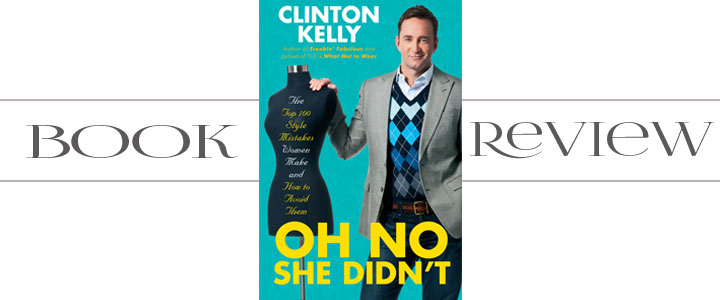
Book Review: Oh No She Didn’t by Clinton Kelly

Oh No She Didn't Oh No She Didn’t by
Published On: October 12, 2010
Genres:
Source:

Buy the Book Goodreads

The Short, Sweet, and Spoiler-Free Blurb:

The atrocities Clinton Kelly has seen—it’s a surprise he hasn’t gouged out his own eyes. Mom jeans? Fancy fingernails? Tracksuits? In the same straight-talking style that has made TLC’s What Not to Wear a smash hit for eight seasons, the cheeky media personality and author of Freakin’ Fabulous shows women how to outfit themselves with confidence and style as he pokes fun at fashion "don’ts."

3 Stars

I’m a bookish person who wants to dress better.  So what do I do? Read a book about dressing better.  I knew more than I thought I would as I was reading it, but I still learned a few style tips.  There were pictures for every single example, so this 200 page book is about half as long as it looks and I read it in an hour.  It is my New Year’s Resolution to not end up in this book.  Clinton Kelly swears a lot and is kind of judgmental, but the whole book was mostly entertaining.  I thought it was funny most of the time, but he could be over dramatic.

My favorite funny quote:

If you are actively participating in a step class . . . I might be able to tolerate [cross-trainers]. But you’re not.  You’re at the mall! You’re at the airport! You’re at the dentist! You are everywhere except at the gym!” – pg 67 Hardcover

Here’s a few of the things I want to incorporate into my style:

  • Mom Jeans = High-waisted, light-wash, taper-leg jeans.  It’s nice to have an official definition.
  • The shoe sets the tone for the outfit. (I need to get better shoes.)
  • Four rules to make an outfit interesting- color, texture, pattern, and shine.
  • Have different jeans for different shoe heights. (What. Now I need more jeans)
  • To start a wardrobe, get a black pencil skirt, gray trousers, dark-wash jeans, khakis, and white walking shorts.  Then get colorful and interesting tops.
  • Dress criteria – v-neck, high, defined waist, and a flared skirt to the knee.

Overall, it was a good, fast way to learn some basic style rules, but I’m glad I got it at the library instead of buying it.

Content Rating: Medium, for language.


About Clinton Kelly

clinton kelly

Clinton Kelly is the co-host of TLC’s popular show What Not to Wear, a spokesperson for Macy’s, and a motivational speaker who has successfully talked thousands of women out of wearing stirrup pants. He received a master’s degree in journalism from Northwestern University and has worked as an editor at several noted fashion publications, including Marie Claire, Mademoiselle, and DNR, a weekly men’s trade magazine. Originally from Long Island, he lives in New York City.

WebsiteTwitterFacebookGoodreadsPinterest


Book Review: The World of Downton Abbey by Jessica Fellowes
16 Jan
2013

Book Review: The World of Downton Abbey by Jessica Fellowes

The World of Downton Abbey The World of Downton Abbey by
Published On: December 6, 2011
Genres:
Source:

Buy the Book Goodreads

The Short, Sweet, and Spoiler-Free Blurb:

Millions of American viewers were enthralled by the world of Downton Abbey, the mesmerizing TV drama of the aristocratic Crawley family–and their servants–on the verge of dramatic change. On the eve of Season 2 of the TV presentation, this gorgeous book–illustrated with sketches and research from the production team, as well as on-set photographs from both seasons–takes us even deeper into that world, with fresh insights into the story and characters as well as the social history.

5 Stars

To watch Downton Abbey is to watch a way of life slowly die with an epic story and it kind of reminds me of Gone with the Wind.  The best part of the TV show is the personal look into the servants’ and nobilities’ lives from the early 1900s and how they interacted with each other.  You really feel transported to the time period and all the characters are interesting and likable yet flawed.  Like any loyal fan would, I bought this book because it had the words “Downton Abbey” on it.  I figured I would love it.  I did and I got more than I expected.

This was more than a behind-the-scenes look at the actors and the locations.  Jessica Fellowes takes history and facts from a time period that is kind of overlooked and just makes that time period come alive.  You get to go on a journey to see how essentially Jane Austen’s time became the world we live in now. She made me care about where the term “weekend” came from and why the Dowager Countess was so baffled by it.

Here are a few of the fascinating morsels that I learned:

  • The whole family will come down for breakfast except the lady because married women get breakfast in bed daily. (Breakfast in bed for Mother’s Day anyone?! Now I feel ripped off because it was just something they got EVERY DAY.  I’m seriously doubting that our modern world is “better.”)
  • You get to see the beginning of things that have survived to modern times like cornflakes from America.
  • Country Houses were being torn down left and right after WWI until The Victoria and Albert Museum had an exhibition called “The Destruction of the English Country House” that saved them.   (That sounds like the most boring exhibit ever but now I’m depressed that I missed it.)
  • Cora’s back story is from a trend during that time of American women coming to England and marrying English lords.  Cora was based on woman in real life named Lady Curzon from the book “To Marry and English Lord.” (Okay, I have to admit that I did not notice Cora was American until I read this book.)

I adored reading all the history and the real life inspirations for the show.  The pictures are beautiful.  The actors give insight into their characters.  You get to read about everything from clothing, family, and society to war and change.   It’s a look into an era that is really the beginning of our modern world and the death of a way of life that had been around for a very long time. This book was the perfect companion to my favorite show.

Content Rating: None.

About Jessica Fellowes

Jessica Fellowes

After graduating in philosophy from the University of Edinburgh, she was a journo on the Mail on Sunday, mainly writing about luxury lifestyle nonsense, celebrity interviews and a gossip column with Celia Walden. Then she went on to be deputy editor of Country Life magazine before leaving to be a freelancer for the Daily Telegraph, Sunday Times Style and The Lady, amongst quite a few others. Wanting to do something different, she started writing books – she recently finished her fifth book, The Chronicles of Downton Abbey. (Photo credit: Beatrix Jacot de Boinod)

BlogTwitterFacebookGoodreads

Book Review: The Curly Girl Handbook by Lorraine Massey + Before and After Pics
24 Sep
2012

Book Review: The Curly Girl Handbook by Lorraine Massey + Before and After Pics

The Curly Girl Handbook by Lorraine Massey The Curly Girl Handbook by Lorraine Massey by
Published On: January 13, 2011
Genres:
Source:

Buy the Book Goodreads

The Short, Sweet, and Spoiler-Free Blurb:

Lorraine Massey, a professional hairstylist and passionate proponent of curly hair, celebrates the curly girl way of life, from hair care to carefree attitude. Beginning with The Curly Girl’s Twelve-Step Program (Step Three: I will accept that the scalp and hair are two different entities with completely different needs, and I will treat them accordingly), "Curly Girl" is an illustrated how-to, support group, and tongue-in-cheek manifesto all in one.

5 Stars

The Curly Girl Handbook is all about how to properly take care of naturally curly or wavy hair.  I found some great insights while reading the first chapter like the preference for straight hair is a subtle form of racism and that 65% of women have curly hair. Yet most hair products are made for women with straight hair and thousands of hair straighteners are sold every year. I felt a big shift in attitude as I was reading about my own curly hair and how I should accept my hair (and ultimately me) for who I am and stop trying to change myself. I related a lot to the stories of women throughout the book that felt different and ugly. There’s a quiz at the beginning of the book to help you find out if you need a paradigm shift in your life. I answered yes to half of the questions. I didn’t think it would be that many. I answered yes to things like almost always being unhappy with the way my hair looks, having constant frizz, and blow-drying my hair then not washing it for a week. I dog-eared so many pages of this library book and referred to it so much that I went ahead and bought it. I refer a lot to the homemade hair product recipes and I want to try them all.  So far, I’ve only made the Lavender Water to spritz your hair to recurl it and I love it.

The book helps you identify your curl type and the specific hair-care routine that goes along with it. I have wavy hair! I have always wanted wavy hair like Megan Fox and I have wished for the longest time to find some way to harness my pretty waves.  I’m going to grow my hair out again and I’m feeling more pretty and confident every day. I thought it was so funny how she describes hair stylists straightening girl’s hair for a special occasion and then curling it with a curling iron. That’s how my hair was done for my wedding!

The writing is kind of cheesy. The author sticks in the words “curl” “mane” and “hair” in lots of places that they don’t belong. And there was a lot of focus on long curly hair – not a lot of extra tips for short curly hair. But other than that I love this book.   I’ve stuck to this hair-care method for 4 months now.  I love that I don’t have to worry so much about my hair.   It’s looking better and better every day.

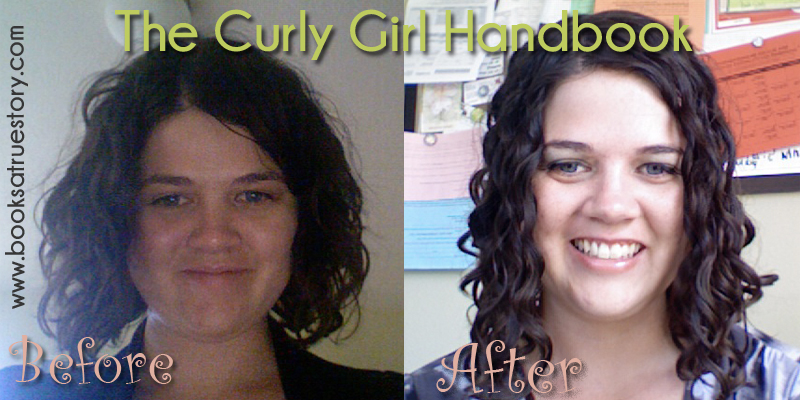
Before and After pictures of the Curly Girl Handbook by Lorraine Massey

The before picture was taken in May 2012.  The after picture was taken 4 months later in September 2012.  I took a lot more photos and kept daily updates on tumblr if you want to see them.  It took a lot of time and some adjustment to get it like this!

The thing I get asked the most is what products I use.  The book is pretty specific about it’s requirements for shampoo, conditioner and gel.

These are the products that I use and love:

Major changes I made from reading this book:

  • No brushing.  I go through my hair with my fingers while it has conditioner in while I’m showering instead of brushing.
  • Use a t-shirt instead of a towel to dry my hair.  A towel will catch and pull your curls apart and make it frizzy and dry.
  • No shampoo. I used conditioner instead of shampoo for a month.  I use sulfate free shampoo now because my hair type does well with it.
  • Use gobs of conditioner.  Curly hair is dry and that’s why it will frizz out – it’s trying to get moisture.  Use lots of conditioner to moisturize it and your hair will be curly instead of frizzy.
  • Use the right products.  I use alcohol free gel in my hair, silicone-free conditioner and sulfate-free shampoo.

If you have naturally curly hair, you need to read this book!

Content Rating: None.


About Lorraine Massey

Lorraine Massey

Lorraine Massey is the founder and co-owner of Devachan, a stylish salon and spa in SoHo in New York City. Her specialty–her passion–is curly hair, and curly girls from the city and afar flock to Devachan for her magic.

WebsiteTwitterFacebook


Book Review: A Preface to Paradise Lost by C.S. Lewis
17 Apr
2012

Book Review: A Preface to Paradise Lost by C.S. Lewis

A Preface to Paradise Lost A Preface to Paradise Lost by
Published On: 1961
Genres:
Source:

Buy the Book Goodreads

The Short, Sweet, and Spoiler-Free Blurb:

An interpretation of Milton’s purpose in writing the epic from the Ballard Matthews Lectures Delivered at University College, North Wales in 1941.

4 Stars

If you have, like me, tried to read Paradise Lost but couldn’t finish it, then this book is a great resource to help you get through it. I learned a lot from this book. Literally on page one C.S. Lewis talks about how people misread narrative poetry (like Paradise Lost) all the time because used bookstores are full of  books of narrative poetry whose first few pages are underlined in random places and the rest of the book is blank. This made me laugh because that’s EXACTLY what my copy of Paradise Lost looks like. C.S Lewis points out that you can’t read it like lyrics looking for little nuggets of good lines. That’s what I did the first time and I quit reading Paradise Lost after 20 pages.

Stuff I learned from this Preface in case you don’t really want to read it:

  • The form of poetry is important and the rules add to it’s beauty, not take away from it.
  • Epic poetry comes from the court so it is meant to be oral. (Good to know – I will try to read it like a speaker instead of a drone voice in my head).  Since its traditionally oral, there is a lot of repetition because if you have to think too much while you are listening to a poem you can get lost very easily.
  • Epic poetry tends to be about men, historically true and tragic.
  • The beauty of the poetry is in the paragraph or the whole. Looking for good lines is like looking for good stones in a cathedral.
  • The language is repetitive but not commonplace, like having pumpkin pie every year for Christmas. This also makes it feel ceremonial.
  • Everything we need to know is in the poem itself.  Another reason I got stuck in Paradise Lost was the massive amount of details. I was delighted when C.S. Lewis said that we don’t need to look up all the places in the notes.  The feeling that Milton is trying to achieve is the important part. Yay for that.
  • Milton purposefully made it feel like you are listening to a never ending voice go on and on. There aren’t many stopping points in the poem.
  • One of the techniques that Lewis suggests in reading Paradise Lost is to immerse yourself in the poem and feel like you are living it yourself instead of trying to strip away all the “exterior stuff.”
  • The idea of hierarchy is seen a lot in Paradise Lost. Everything has a superior (except God) and an inferior.

Then Lewis talks a lot about heresy and whether or not it’s there in Paradise Lost (which I didn’t much care about).

So there you have it. I feel properly prepared to read Paradise Lost and actually finish it this time.

Content Rating: None

About C.S. Lewis

cs Lewis

CLIVE STAPLES LEWIS (1898–1963) was one of the intellectual giants of the twentieth century and arguably one of the most influential writers of his day. He was a Fellow and Tutor in English Literature at Oxford University until 1954, when he was unanimously elected to the Chair of Medieval and Renaissance Literature at Cambridge University, a position he held until his retirement. He wrote more than thirty books, allowing him to reach a vast audience, and his works continue to attract thousands of new readers every year. His most distinguished and popular accomplishments include Mere Christianity, Out of the Silent Planet, The Great Divorce, The Screwtape Letters, and the universally acknowledged classics The Chronicles of Narnia. To date, the Narnia books have sold over 100 million copies and been transformed into three major motion pictures.

WebsiteTwitterFacebookGoodreads

Book Review: Out of Africa by Isak Dinesen
26 Jul
2011

Book Review: Out of Africa by Isak Dinesen

Out of Africa Out of Africa by
Published On: 1937
Genres: ,
Source:

Buy the Book Goodreads

The Short, Sweet, and Spoiler-Free Blurb:

Out of Africa is Isak Dinesen’s memoir of her years in Africa, from 1914 to 1931, on a four-thousand-acre coffee plantation in the hills near Nairobi. She had come to Kenya from Denmark with her husband, and when they separated she stayed on to manage the farm by herself, visited frequently by her lover, the big-game hunter Denys Finch-Hatton, for whom she would make up stories "like Scheherazade." In Africa, "I learned how to tell tales," she recalled many years later.

3 Stars

This reads more like a collection of short stories of things she remembers from having a coffee farm in Africa. They are true stories which makes it more interesting to me. It can get a little dry since there is no overall plot, but it’s still a fascinating look at a different life and times. Isak Dinesen was a pen name for Karen Blixen and she was an inspiring and independent woman.  The book is pretty similar to the movie.  I really liked it.

Content Rating: None

About Isak Dinesen

Isak Dinesen

Karen Christence Dinesen, Baroness Blixen-Finecke – wrote as Isak Dinesen, Pierre Andrézel, other pseudonyms: Tania Blixen, Osceola, etc.
A Danish writer, who mixed in her work supernatural elements, aestheticism, and erotic undertones with an aristocratic view of life, Blixen always emphasized that she was a storyteller in the traditional, oral sense of the word. She drew her inspiration from the Bible, the Arabian Nights, the works of Homer, the Icelandic Sagas, and the fairy tales of Hans Christian Andersen, who was her great fellow countryman. She wrote in English and in Danish.

Baroness Karen Blixen was born in Rungsted, Denmark, into a well-to-do patrician family. She was the daughter of Ingeborg Westenholz Dinesen, and the writer and army officer Wilhelm Dinesen, whose adventuresome spirit and storytelling talents influenced deeply Blixen’s imagination. She spent her childhood on the family estate in Rungsted. Throughout her life Blixen’s outlook and manner were unabashedly aristocratic.